A sincere testimonial isn't evidence
At some point perhaps fifteen years ago, I got bit by the self-development bug. You've probably been bit too. It seems common in these parts.
It's basically good, I'm convinced. All the self-help books, courses, trainings, and coaching surely amount to something. Maybe we're wasting some time navigating an infinitely generated world trying to optimize something that can't be optimized, but... things do change. Slowly and surely, we unravel tied knots, hopefully faster than we're tying new ones.
Certainly this is the case for me. I have no negative self talk, and significantly less body tension. I procrastinate less, get things done more, and have far fewer hangups. People seem to like being around me. My contemplative practice finally started paying out.
Yet, I have a bit of a confession, both for myself and on behalf of most self-improvement seekers. We have no clue what works, even when it's working.
Art of Accomplishment is pretty good. I participated closely in their offerings for over a year, wrote a review about my experience, and know of at least a couple dozen people who took their Master Class because of my review. Many people have reached out thanking me for pushing them over the edge, that they also had a transformative experience. For a while, AoA had my review on their homepage. I'm sure for many people, I'm the AoA-guy. Hi.
When I read my review back, I cringe a bit. Again, AoA is pretty good. What's that cringe then? Why don't I feel fully right with the level of endorsement that I gave?
Ironically, in AoA courses, you're not supposed to give advice to each other. This is wise, because while advice can be very real, the chance I know what's best for you is quite slim. You experience the world differently than me, have different patterns, and want different things.
Yet my review communicated to people: Hey, it's THAT good, I had such a great experience, you'll do well too. I wrote it in earnest and with enthusiasm, but it doesn't feel like something I want to vouch for anymore. This feels strange, though, since I keep being told that people have had a great experience.
Here's the actual confession: I'm not sure it did all that much for me.
The culmination of my Master Class experience was a live coaching session with Joe. I have it downloaded and rewatched it. I brought a vulnerable issue, something that felt hopelessly stuck. Three years on, I can see his diagnosis was only partially right. He spotted something that I hadn't seen: a way I was managing a person close to me that I'd mistaken for care. There was also a vast floor under it and his prescription wasn't right. He saw the top of the stack, while I walked away with the perception that he saw everything. Of course — he didn't know me, how could he entirely diagnose what I needed?
I remember—and in the recording, see myself—feeling seen. Whoa, this is it. We've found it. I had the stark perception of a shift.
And, aside from this experience, shifts do happen. Some are gradual, some are a pop. Yet I've had several wonderful experiences that also felt significant but didn't change much. From the inside, can we even tell the difference? That entanglement feels like vertigo. The feeling of change and change are different things, even when they feel the same.
I was curious. Was it just me? I've known several people who had similar live coaching experiences with Joe, so I asked them how things evolved. Universally, everyone admitted that their point-in-time perception of what happened, and the perception much later, were quite different. A couple still remembered their sessions fondly, but that it wasn't quite what they thought it was. Some admitted basically nothing changed. No one faulted AoA, Joe, or themselves.
It seems everyone involved—from Joe, to the other AoA staff, to me, to readers who have taken their courses—are deeply sincere. And yet, the outcome of the system misinforms the next person about what may be possible.
Sincerity is not evidence.
Since I took the course, AoA's social media has ramped up. On YouTube, they post live coaching recordings, showing what Joe can do.
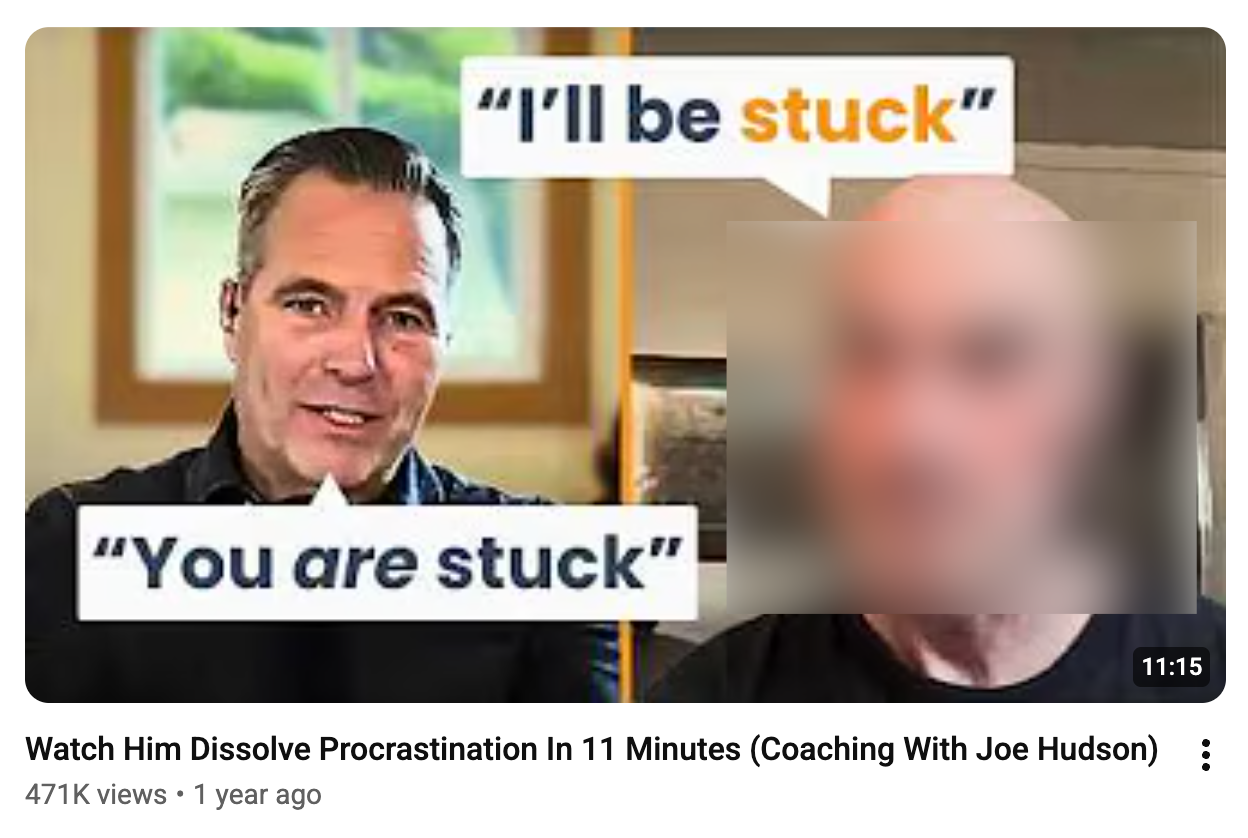
Have a similar problem or have a stuckness that you want fixed? It's so appealing. From there, you sign up on waitlists. For many of their offerings, you then have to be invited to apply. There's an air of exclusivity, prestige, and urgency. There are deadlines that activate fear of not being included. Yet, it's neatly wrapped in a package that doesn't take itself too seriously. Joe's twitter handle is "FU Joe Hudson", and complaining about AoA is totally within the realm of things that could happen in a course.
Once in there's energy pushing towards let's do this. It'll be hard, but embrace the fear of vulnerability and open up. Much of the programming isn't actually about live coaching. It's mostly gently facilitated live practice that gets people out of head-mode and into experiencing-mode, where emotions, relating, and intuition lie.
Here's one of them. Someone asks what you want, you answer, they ask what's under that, you answer, they ask again. You both keep going. The first answers are clever, and then the cleverness wears off, and what's left is rawer and a bit truer, showing wants under the wanting. There's a real felt shift when you touch the rawness under there. It's lovely.
Functionally, the live coaching might be the door that makes the other real work findable. Or perhaps those I know are unusual, and people do indeed have lasting change from the coaching. But, even the "real work" is socially mediated. Pairs, small groups, and large groups where this is a great thing, look at us change is the default frame.
Slowly, I realized they sell—at scale and by design—this exact felt sense of "shift" and "change" that I experienced. This is the cringe I feel now: not that they do it, but that I did it too, in miniature, with my one earnest review. I sold the feeling as proof.
Focusing on "felt change" seems to be a structural problem, not a moral one. The product doesn't, and perhaps can't, follow up. No one after my coaching session checked in later to see what had actually happened. No one after doing a year-long program followed up to see how I had shifted and changed.
That's not what they offer, they're not in the business of actually tracking outcomes. The clickbait claims float free of actual feedback.
They're not alone. This is the norm in the industry. Chris Lakin has been on this beat for a long while.
This is all a bit odd because change does happen, both in courses like AoA and outside. Sometimes it just happens, sometimes it takes life circumstances to break a local optimum, and sometimes it's deliberate practice.
I've experienced fairly radical change. But I reported this before, no? What's believable? Or better, what's useful for you?
I know several people who would emphatically say AoA changed their life, pointing to emotional attunement, relationships, and even kids that would not exist without the courses.
The best I can tell is that resilient change has minimal story. There doesn't need to be an arc, because the generator function of behavior and perspective shifted. It lasts. There's common Buddhist advice that once you have a radical spiritual shift, wait a year before you trust it. And probably most importantly: it's accompanied by external in-the-real-world changes.
What can you do that you couldn't before? Not just what you feel, but what's different that someone else would notice? It could be an ability, such as taking social risk. Or it could be a thing that you stopped automatically doing.
A few days ago, I got another email from someone who was having a lovely AoA experience, thanking me. It has been everything he wanted and more. I hope that's true, and I also remember feeling that.
Here's what I think is happening: the courses are seeds for embodied self-authorship, passed through views, practice, and warm community. It's an environment where you're not doing it alone, supported by material created to help people refine their own self. It can't do the work for you, and also is fairly fixed. You take the seed and hope something grows. Perhaps immediately, you notice shifts. Perhaps instead it ends up being the beginning for what grows far later. It's all muddy. People do seem to change and get better, but the causality arrows are all mixed up.
Still, it may have helped in ways that aren't legible. I'd be happy with that.
The courses seem good—as in, practically useful—if you're a successful in-your-head high achiever, who would benefit from practicing the skills that shift towards more emotional and relational attunement. The live coaching may help people, but primarily functions as a hook to show people, in an artificial way, what may be possible.
There's a failure mode. The experience can be fun, especially if you're like me and love the sensation of movement and progress. Yet this can end up being its own trap. I know several people who seem sort of stuck in the AoA orbit. They take every course, many times repeatedly, and have become the AoA model, using AoA language, taking the organization as part of their identity. If the goal is embodied self-authorship, perhaps this isn't right.
Change is real and flaky breakthroughs are everywhere, both at once. The industry's incentives aren't aligned toward lasting change, and sometimes it produces lasting change anyway. I can't tidy this better.
In fact, I wish I had a cleaner story for you. Effective recommendation needs the person in front of you, and an essay has no one in front of it. I can see my friends, I can't see you. So I won't tell you what to do.
I'm leaving the review up. My experience was real and pulling it down feels also wrong. I've gently updated the end with some more context.
A sincere testimonial isn't evidence, mine included.